Haynes Column: What SID Eurodisplay 2026 in Dublin Signals for Display Tech
2026-10-21 · via invidis
Dave Haynes attended SID Eurodisplay 2026 in Dublin, the European chapter's smaller, biennial counterpart to the main Society for Information Display conference held annually on the US west coast. The event drew about 100 attendees, mostly engineers and PhDs, for roughly 50 technical presentations over three days. There was little in the way of a trade show, just a small tabletop exhibit area for coffee breaks.
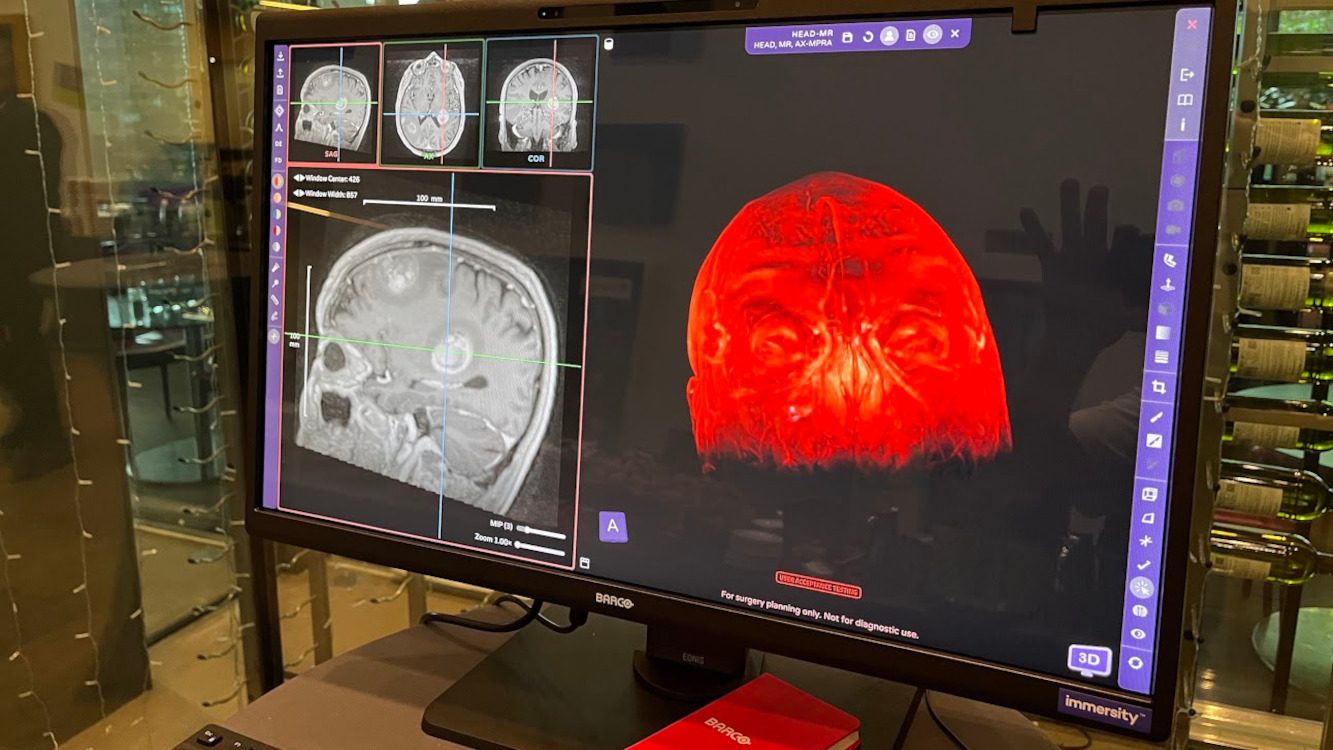
For digital signage professionals, the write-up is less about products to buy now and more about where display technology is headed years out. One live demo was a Barco Eonis 3D monitor, an autostereoscopic (glasses-free) display aimed at medical imaging, which can also switch to standard 2D. Haynes notes glasses-free 3D has repeatedly failed to gain traction in signage because it tends to be sold as a novelty rather than solving a business problem, though medical imaging has a clearer case for the added depth cues.
MicroLED still has production hurdles
MicroLED was a major topic, with presentations reinforcing the view that the technology suits small displays more than large video walls, since its high pixel density matters less for screens viewed from a distance. SID chair Qun Yan detailed ongoing manufacturing challenges, particularly inspection methods for detecting dead pixels and balancing speed, accuracy and chip damage during production. According to the piece, Asian manufacturers including TCL, AUO, Vistar and Tianma see potential for tiled MicroLED video walls eventually, but nearer-term opportunities are seen in wearables, portable devices and auto dashboards.
A competing technology for those smaller form factors came from Germany's Fraunhofer Institute, which presented a full-color RGBW OLED micro-display at 5,040 pixels per inch intended for wearables, far denser than typical fine-pitch COB LED video walls.
Haynes concludes SID-style events offer limited value for signage sales and business development staff since attendees skew heavily technical rather than toward integrators or end users.
The announcement in full
Reproduced from invidis for reference. Digital Signage Magazine did not write the text below.
From MicroLED to 3D glasses-free signage - and don't forget Guinness and Kerrygold: Dave's takeaways from SID Eurodisplay 2026.
The Society for Information Display (SID) runs a pretty substantial conference and integrated trade show every year on the US west coast that pulls display nerds from across the globe, attending to get a sense and early look at where the digital display business is or might be going.
What you see at an SID event reflects what might be finished display products, or in the composition or manufacturing of display products, five or more years out.
Every second year, the European chapter of SID also puts on a conference – called Eurodisplay. The last one was in Grenoble, France and the latest was put on recently in Dublin.
That city is a five-ish hour non-stop flight from Halifax (where I live), so I decided to hop over and see how it compares with the main show, which I’ve attended two or maybe three times. I’d have gone more often, but the timing is usually very close to Infocomm week.
It didn’t hurt that Eurodisplay was being staged this time in the land of Guinness stout (yeah, it is way better in-country) and Kerrygold butter (up there with French butter, and puts mainstream North American stuff to shame).
Eurodisplay is much smaller, organized and put on entirely by volunteers like much-loved industry vet Sam Phenix, who does her LED consulting and advisory from a home office up the coast in County Down. The event pulled about 100 industry people, most of them engineers and PhDs, presenting and discussing stuff way the hell over my big, largely empty head.
Here’s one of the topics explored: Inorganic halide perovskite thin films realized by pulsed laser deposition over large area for MicroLEDs color conversion layers.
Most of the presentations were along those very technical lines – something I discovered years earlier at my first SID in (I think) Silicon Valley. I sat down in a lecture theater, and realized after a couple of slides I was not going to gain much insight, because I had only the most fleeting grasp of the science. So I ducked out and skipped most of the presentations.
Like most lay people – or however you want to describe doofuses like me – I’m super interested in what these technology advances might do for finished products and applications. But I don’t terribly need to learn the granular technical details of chemicals, circuitry and manufacturing processes.
Eurodisplay had about 50 technical presentations over three days, as well as a teeny, tabletop level exhibit area intended for coffee breaks. The event is all about learning, as opposed to hands-on stuff.
The only display tech to ogle was a Barco Eonis 3D monitor – a working demo of a glasses-free display aimed at the medical imaging sector. The monitor is autostereoscopic (so … “naked-eye” 3D) but it can also be switched to conventional 2D.
People who have been around this business for a decade or two will recall numerous attempts to make glasses-free 3D displays into a thing. Very few have gained any traction, in part because they’ve been marketed more on the novelty of stuff seemingly (OMG!!!) jumping off a flat display surface.
Like a lot of novelty displays, it’s interesting once or twice for onlookers. After that, yeah … whatever …
High-rez medical imaging, however, has a specific value for diagnostics and therefore a business case. I assume anything that provides more granular detail and the ability to view different angles would please radiologists.
I’ve seen Sony’s spatial display, as well as demos from big manufacturers like BOE, so Barco has competition in monitors that achieve similar visual effects and outputs.
My head is all around digital signage and information displays, and while I see these sorts of things as interesting, there is little to no application for 3D displays in the vast majority of jobs that get cooked up and deployed in retail, workplace, mass transport or elsewhere.
MicroLED still has production hurdles to clear
There were numerous presentations about MicroLED, and they tended to reinforce my thinking in the last couple of years … that the tech is more geared to small displays than big video walls. Yes, MicroLED makes it possible to manufacture displays that pack an incredible number of tiny light emitters into a square inch, but why is that useful for displays that are typically viewed from several steps back?
How many consumer or commercial 8K flat panels got made, sold and shipped?
Plus Chip-On-Board (COB) video walls, already mass manufactured with well-established and proven technology, are very arguably more than adequate for the majority of large-format indoor display jobs out there.
The other thing about MicroLED, which has been a running story for several years now, are the engineering hurdles R&D teams are still trying to clear.
SID chair Qun Yan, a display expert and professor at a Shanghai university, did the opening talk in Dublin. He walked through the numerous challenges, notably the inspection technologies used to determine the percentage and location of dead pixels coming out of manufacturing runs.
In the context of MicroLED displays, yield is the percentage of working light pixels on a display module coming off a manufacturing line. The quest has been to get to 99 and a bunch more 9s percent, so that dead pixels are absolutely minimal and the display viable to sell and ship.
With high throughput tech, the “miss rates” for things like electrical defects on light chips can be quite high. Using another method called full parametric (beats me what that means) the inspection process is slow and the light chips can suffer “significant physical damage.”
Yan walked through several ways to balance speed, accuracy and inspection damage using tools and methods like magnetic fields, plasma and “stretchable electrodes.” You can maybe understand why I was in the back, in rapid eye-blink mode, minimally grasping all this.
Asia display manufacturers like TCL, AUO, Vistar and Tianma say they see potential for large format video displays using tiled MicroLED units, but in the nearer term the market may be more for products and components like wearables, portable devices and wide, often curved auto dashboards.
But MicroLED has a challenger in that space.
OLEDs are the go-to tech for wearables and handheld devices like your smartphone. Now the Dresden, Germany-based Fraunhofer Institute is talking up a full-color RGBW OLED micro-display that has a mind-melting 5,040 PPI (pixels per inch) intended for wearables.
For reference, a fine pitch COB LED video wall product would typically have about 28 pixels per inch. The produced unit is less than a quarter inch wide, and maybe a third the size of a coffee bean.
So … was it worth the trip over? Probably not because of my absolute lack of technical chops, and the minimal trade show component. But the Guinness, Beamish and Murphy’s side-research I did was highly beneficial.
Digital signage sales and biz dev people who go to events looking to generate leads or build partnerships would likely be reading emails and looking up the best pubs in Temple Bar to hit that evening. SID events are not target-rich environments full of integrator and end-users.
But if you are highly technical, and want to understand what’s on the display tech horizon, SID events are very good.