LG's UP5Q Becomes First Display to Pass All SignageOS SoC Benchmarks
2026-09-29 · via invidis
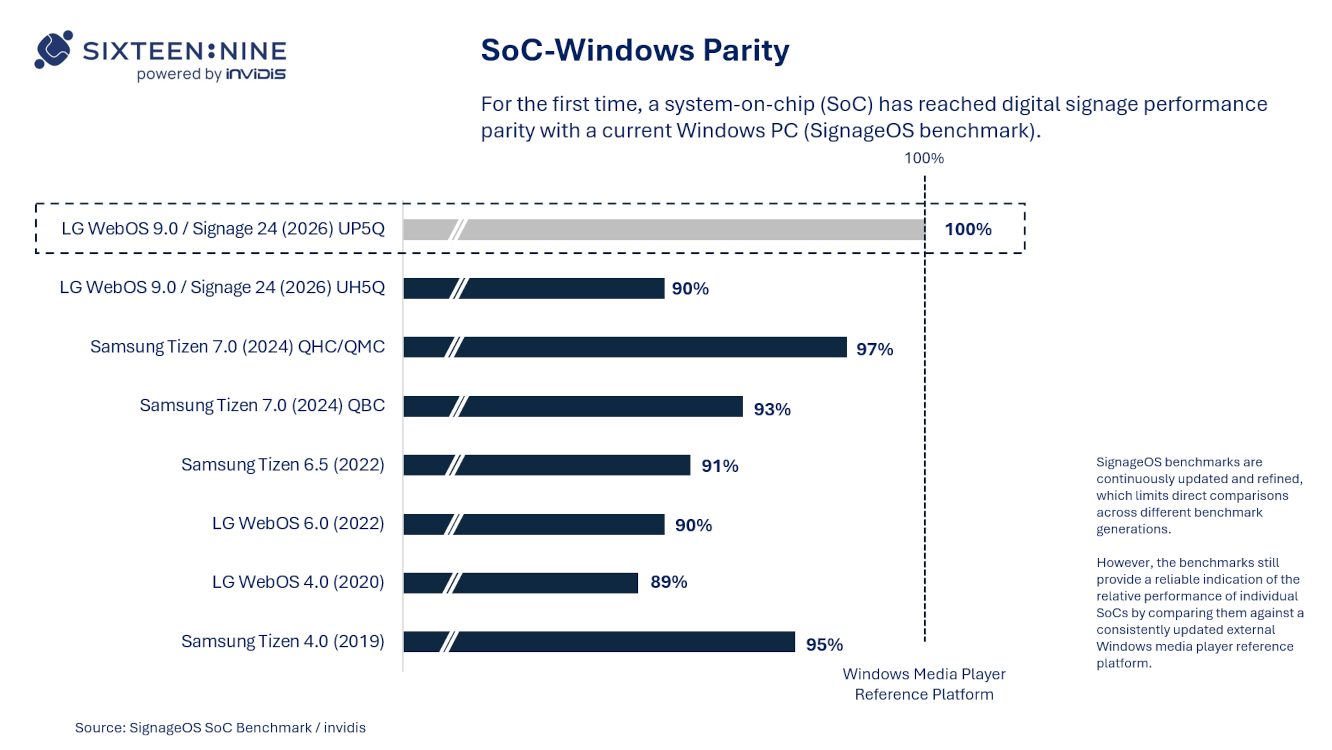
A new benchmark report from SignageOS, published with content provider Screenfeed, says LG's UP5Q series is the first display platform in the seven-year history of its benchmark program to pass all 60 test scenarios. That matters for anyone specifying hardware, because it puts a system-on-chip display on par with a dedicated Windows PC on the tests SignageOS runs, according to the report.
The UP5Q runs LG's webOS 9.0 platform. According to the results, it achieved gapless UHD playback in both landscape and portrait orientation using H.265 video, and showed no measurable drop in performance moving from Full HD to UHD workloads. It also passed all three of Screenfeed's HTML5 workloads, which the report describes as demanding content scenarios with dozens of animated elements for news, weather and sports.
Two tiers, one operating system
The report also benchmarks LG's mainstream UH5Q series, which runs the same webOS 9.0 software but on different hardware. The UH5Q passed 54 of 60 scenarios, a 90 percent score. Five of its six failures involved UHD workloads, and the sixth came from the most demanding HTML5 test. It passed every Full HD video scenario tested.
That split matters for buyers. The report's conclusion is that the UH5Q is sufficient for many everyday signage deployments, while UHD playback, browser-heavy applications or complex mixed-content scenarios call for the extra headroom of the UP5Q.
What the benchmark actually measures
Rather than one aggregate score, SignageOS breaks results into 15 individual test groups, which the company says lets integrators match a platform's performance to a specific job, such as a Full HD menu board versus a UHD lobby display or a synchronized video wall. The report also compares both LG tiers against a Windows 11 media player, giving a reference point for projects where external compute is still part of the design.
Lukas Danek, CPO and co-founder of SignageOS, is quoted saying each SoC generation the company has tested has closed gaps the last one couldn't, from struggles with simultaneous playlists on webOS 4.0 to UHD limitations on webOS 6.0. He argues the UP5Q closes the remaining gap and that the buying question is no longer whether SoC displays are capable enough, but how much performance headroom a deployment needs.
That's a claim from SignageOS and LG's own commissioned validation, not an independent third party outside that relationship, and it's worth reading in that context. The report does not say what happens with content types outside its 60 test scenarios, nor does it give pricing for either LG tier. It also does not address how the UP5Q and UH5Q handle long-term reliability or firmware updates over a multi-year deployment, which are separate questions from raw playback benchmarks.
For integrators, the practical takeaway is narrower than the framing suggests: mainstream Full HD deployments look well served by integrated SoCs, external media players still have a role in UHD-heavy, AI-driven or highly interactive installations, and rising memory prices are making that external hardware more expensive to justify for standard use cases.
The announcement in full
Reproduced from invidis for reference. Digital Signage Magazine did not write the text below.
System-on-Chip platforms have long promised to eliminate the need for external media players in digital signage deployments. According to a new benchmark report by SignageOS, LG's latest WebOS 9.0 platform reached a new milestone. The premium UP5Q series became the first display platform in the history of the SignageOS benchmark program to successfully pass all test scenarios, providing a new reference point for SoC-based digital signage.
For digital signage integrators, CMS providers and end users, the report delivers a detailed workload-by-workload analysis of LG’s two webOS 9.0 hardware tiers and highlights where an integrated SoC is sufficient and where an external media player may still add value.
First display platform to pass every benchmark
Published by SignageOS in cooperation with content provider Screenfeed, the report evaluates LG’s latest professional display portfolio powered by WebOS 9.0. The standout performer is the LG UP5Q series, which passed all 60 benchmark scenarios, a first across all platforms tested since the benchmark program was launched seven years ago. That puts LG’s premium digital signage screen en par with the performance of a current Windows PC.
Notably, the UP5Q was also the first webOS-based display to achieve gapless UHD playback in both landscape and portrait orientations using H.265 encoded video. According to the results, the platform showed no measurable performance degradation when moving from Full HD to UHD workloads.
The display further passed all three of Screenfeed’s real-world HTML5 workloads, including demanding content scenarios featuring news, weather and sports applications with dozens of simultaneously animated elements.
Two hardware tiers, one operating system
One of the most interesting findings of the report is the distinction LG has created within the WebOS 9.0 ecosystem.
While both the UH5Q and UP5Q series run the same operating system, they target different performance requirements. The mainstream-oriented UH5Q successfully passed 54 of 60 test scenarios, achieving a 90 percent score overall. Five of its six missed scenarios were linked to UHD workloads, while the remaining challenge came from the most demanding HTML5 benchmark.
Importantly, the UH5Q passed every Full HD video scenario, including:
For many everyday signage use cases, these results suggest that the UH5Q provides more than sufficient performance. However, projects involving UHD playback, browser-intensive applications or advanced mixed-content scenarios benefit from the additional processing power offered by the UP5Q platform.
A more practical approach to benchmarking
Rather than relying on a single aggregated score, the report divides results into 15 individual test groups , allowing stakeholders to match performance directly to deployment requirements.
For example, a customer planning a Full HD menu board network can evaluate different criteria than an operator deploying a UHD corporate lobby display or a synchronized multi-screen video wall. The granular approach makes it easier for integrators and end users to determine which hardware tier best matches their content strategy.
The benchmark also compares both LG display tiers against a dedicated Windows 11-based media player, providing a useful reference for projects where external computing power remains part of the design consideration.
The report highlights the rapid evolution of integrated signage platforms over the past decade.
“Every SoC generation we benchmark closes gaps the previous one couldn’t,” said Lukas Danek, CPO and co-founder of SignageOS. “WebOS 4.0 struggled with simultaneous playlists, WebOS 6.0 solved that but not UHD, and now UP5Q has closed that gap too. The takeaway for buyers is that SoC displays are no longer catching up to mainstream signage needs. They’ve moved past them, and the question has become how much headroom you want for what’s next.”
The statement reflects a broader industry trend. As modern SoCs become increasingly powerful, the traditional argument for external media players becomes less compelling for a growing number of deployments. Especially in current times, where memory prices have tremendously driven up external media prices.
While the largest experiential installations, AI-driven applications and highly interactive projects may still require dedicated computing hardware, many mainstream digital signage deployments can now run natively on the display itself.
For LG, the report provides independent validation of its WebOS strategy and reinforces the company’s position among leading SoC-based signage platforms. For integrators, the benchmark delivers practical guidance when specifying hardware for different project scales and content demands.
Perhaps most importantly, the findings suggest that the industry has reached a new phase in SoC development. The discussion is shifting away from whether integrated platforms are capable enough and toward determining which performance tier offers the right balance of cost, scalability and future-proofing.
Opinion : Why SoC Is Now the Rational Choice
PC-Parity : LG Sets New Standards for SoC Performance