LISNR Ultrasonic Audio Tech Now Integrates With Samsung VXT Signage
2026-10-23 · via AV Magazine
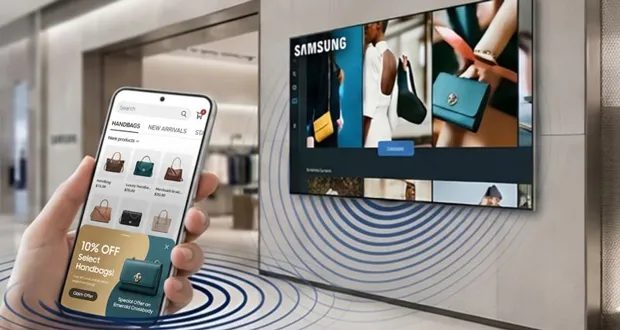
LISNR has announced an integration with Samsung VXT that lets digital displays send promotions and other content directly to nearby shoppers' phones using ultrasonic audio tones, rather than QR codes or Bluetooth. For operators running retail, restaurant or venue networks, this is another attempt to close the gap between a screen playing content and a customer actually doing something with it on their own device.
The mechanism works through LISNR's data-over-audio technology, which encodes data into inaudible high-frequency sound. Content creators attach that data to specific media assets inside Samsung's VXT Canvas interface. When the asset plays on a Samsung display, the screen's built-in speaker emits the tone alongside the visible content. A shopper with the retailer's app installed on their phone can pick up that tone and receive the linked content, whether that's a promotion, a contactless checkout trigger, wayfinding information or localised customer support.
According to LISNR, because the system relies on sound rather than Wi-Fi or Bluetooth, it avoids the connectivity and pairing issues that have limited other proximity marketing approaches, and the company describes it as a more privacy-friendly link between screen and device. The announcement does not specify which Samsung VXT display models support the feature, what the phone-side setup requires beyond having the merchant's app installed, or whether there is a cost to retailers beyond existing VXT and LISNR licensing.
What it means for operators
The pitch here is familiar: turn a screen that shoppers mostly ignore into something that drives a measurable action on a phone. QR codes already do this without any special hardware or audio requirement, and the announcement does not explain what LISNR's ultrasonic approach does that scanning a code does not, beyond removing the scanning step itself. That could matter in quick-service or high-traffic environments like stadiums and malls, where getting someone to stop and aim a camera at a screen is friction retailers want to avoid.
The requirement that shoppers already have the merchant's app installed is a real limitation. This is not a tool for converting anonymous foot traffic; it is a tool for deepening engagement with people who are already inside a retailer's ecosystem. LISNR chief executive Eric Allen frames the deal as building a "three-sided commerce ecosystem for merchants, brands and consumers" and says it helps bridge what he calls the "attribution gap between physical screens and mobile engagement," though the release gives no detail on what attribution data the integration actually surfaces to retailers.
For signage operators already on Samsung VXT, this adds a feature to the content workflow rather than requiring new hardware, since it uses the display's existing speaker. Whether retailers adopt it will likely depend on how much value they see in ultrasonic delivery over a visible QR code, something the announcement leaves for the market to decide.
The announcement in full
Reproduced from AV Magazine for reference. Digital Signage Magazine did not write the text below.
By AV Magazine in Products October 22, 2026 0
Data-over-audio technology company LISNR’s integration with Samsung VXT allows retailers to send information by way of ultrasonic tones directly to in-store customers’ mobile phones.
A data-over-audio technology company has announced a Samsung VXT integration that enables enables digital displays to deliver relevant promotions directly to a nearby shopper’s phone, without requiring them to scan a QR code.
Businesses can use LISNR’s data-over-audio technology to send ultrasonic tones to consumer smartphones through the merchant’s app, triggering on-screen promotions, contactless checkout, wayfinding and localised customer support.
The integration allows retailers, quick-service restaurants, hospitality networks and high-foot-traffic venues such as malls and stadiums to convert passive commercial displays into active, secure touchpoints capable of driving real-time interactions with customer smartphone apps.
The entire workflow is managed within the VXT Canvas interface, allowing content creators to ‘attach’ digital data to specific visual media assets.
Bypasses traditional connectivity barriers When the media plays on a Samsung display, the corresponding audio tone plays concurrently through the screen’s built-in speakers. As the technology relies purely on sound rather than Bluetooth or Wi-Fi, it bypasses traditional connectivity barriers, ensuring a privacy-friendly link between the Samsung screen and the customer’s mobile device.
LISNR chief executive Eric Allen said: “Our collaboration with Samsung marks a significant milestone in the evolution of physical merchant experiences, enabling a unified, three-sided commerce ecosystem for merchants, brands and consumers.
“By combining our secure ultrasonic data-over-audio technology with Samsung’s industry-leading display platform, we are transforming static digital signage into active commerce media channels that drive real-time interaction.
“Merchants can now activate their existing infrastructure to deliver immediate, context-aware value directly to consumers’ devices, bridging the attribution gap between physical screens and mobile engagement.”