Looking Glass Launches 43-Inch Display That Switches Between 2D and Hologram Mode
2026-11-19 · via AV Magazine
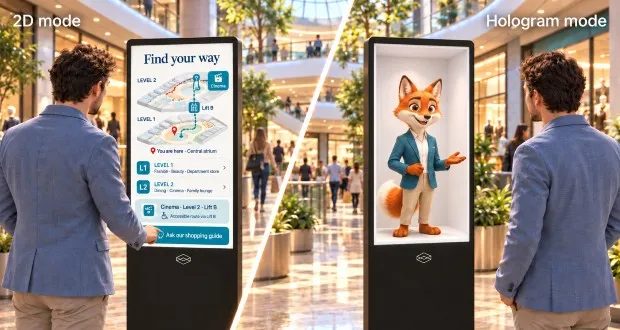
Looking Glass has introduced a 43-inch display it calls the Hololuminescent Display (HLD), which the company says can switch between standard 2D digital signage and a group-viewable hologram mode without headsets or 3D glasses. The product is aimed at operators who want spatial content without dedicating a screen to it full time.
According to Looking Glass, the display keeps full native 4K resolution in both modes and is no thicker than a standard commercial display, despite producing what the company describes as perceived holographic depth more than ten times the panel's physical thickness. Switching between 2D and hologram mode is handled by software that changes the display's optical state, and can be triggered through a preloaded content playlist or remotely via a content management system.
For operators already running 2D campaigns, that switching mechanism is the pitch: existing creative stays in rotation, and the hologram mode gets turned on selectively, for example to draw attention or support an interactive moment. Shawn Frayne, Looking Glass co-founder and chief executive, said the company has built holographic displays for over a decade but called the 43-inch HLD a breakthrough because of the volume of 2D content already in circulation.
The company is also launching Hologramify, an AI feature that lets a creator pick an object or character inside a 2D ad and convert it into a hologram in under a minute, according to Looking Glass, with no 3D modeling required. The announcement does not say what file formats or source material the tool accepts, or how the converted asset is managed within a playlist.
Hardware and software options
Listed specs include 2,160 by 3,840 pixel resolution, 10-point capacitive touch, internal compute, built-in speakers, Wi-Fi, an HDMI input and a 3.5mm AUX output. Looking Glass has also partnered with Proto Hologram to offer its ProtoOS platform on the HLD by subscription, which the release describes as the first time ProtoOS has been built into a partner's hardware. The HLD Premium tier is pitched as a complete out-of-box solution that does not require a connected PC or Mac, with live 4K holographic video streaming, customizable avatars, access to Proto's app ecosystem, and a remote dashboard for fleet scheduling including 2D/hologram switching.
Proto Hologram founder and chairman David Nussbaum said the partnership gives Looking Glass customers tools refined in what he called real-life activations.
The announcement does not include pricing for either the base HLD or the Premium ProtoOS tier, nor does it specify brightness, viewing angle, or durability ratings relevant to commercial deployment. The HLD is available for pre-order, with shipping said to begin in February. The release does not give a year.
The announcement in full
Reproduced from AV Magazine for reference. Digital Signage Magazine did not write the text below.
By AV Magazine in Products November 18, 2026 0
The 43” Hololuminescent Display, which is also available with an integrated ProtoOS platform, extends holographic experiences from specialty installations into everyday digital signage.
Looking Glass has launched the first digital signage solution capable of switching between regular 2D and hologram modes.
The 43” Hololuminescent Display (HLD) can show conventional 2D signage, then switch to group-viewable hologram mode, preserving full native 4K resolution at all times.
Despite being as thin as a regular display, it is capable of presenting perceived holographic depth of more than 10 times its physical thickness when in hologram mode. No headsets or 3D glasses are required to view the holographic content.
The hologram mode is activated by software that changes the display’s optical state. Switching can be activated by a pre-loaded content playlist or triggered remotely through a content management system.
Looking Glass’s new AI-powered Hologramify feature lets creators select an object or character in a 2D advertisement and turn it into a hologram in less than a minute, with no 3D modeling skills required.
The HLD offers a resolution of 2,160 by 3,840 pixels, 10-point capacitive touch, internal compute, built-in speakers, Wi-Fi, an HDMI input and a 3.5 mm AUX output for external speakers.
The company has also partnered with Proto Hologram to bring its ProtoOS to the HLD by subscription – the first time the spatial signage platform has been built into a partner’s hardware offering.
The HLD Premium tier gives customers a complete solution for live holographic communication and interactive experiences right out of the box, without the need for a PC or Mac.
HLD Premium customers can stream live 4K holographic video of people, customise and deploy self-contained avatars and access Proto’s app ecosystem. A remote dashboard controls fleet scheduling, including 2D/hologram switching.
Shawn Frayne, co-founder and chief executive of Looking Glass, said: “Our team has developed all manner of holographic displays for over a decade, but the 43” HLD is the breakthrough I’m most excited about for one simple reason – there’s a whole lot of 2D content out there.
“Operators no longer need to dedicate a screen permanently to spatial content. They can keep using their existing 2D campaigns, then programme the display to switch into hologram mode when they want to attract attention or enable deeper interaction.”
Proto Hologram’s founder and chairman, David Nussbaum, added: “Digital signage is all about memorable experiences and scalable utility.
“By powering their new thin switchable spatial display with ProtoOS, the innovative team at Looking Glass is providing its customers with tools we’ve tested and refined in real-life activations, opening up a world of possibilities.”
The HLD is available to pre-order , with shipping starting in February.