Op-ed: Place-based DOOH in clinics and senior centers aids public health outreach
2026-11-10 · via Digital Signage Today
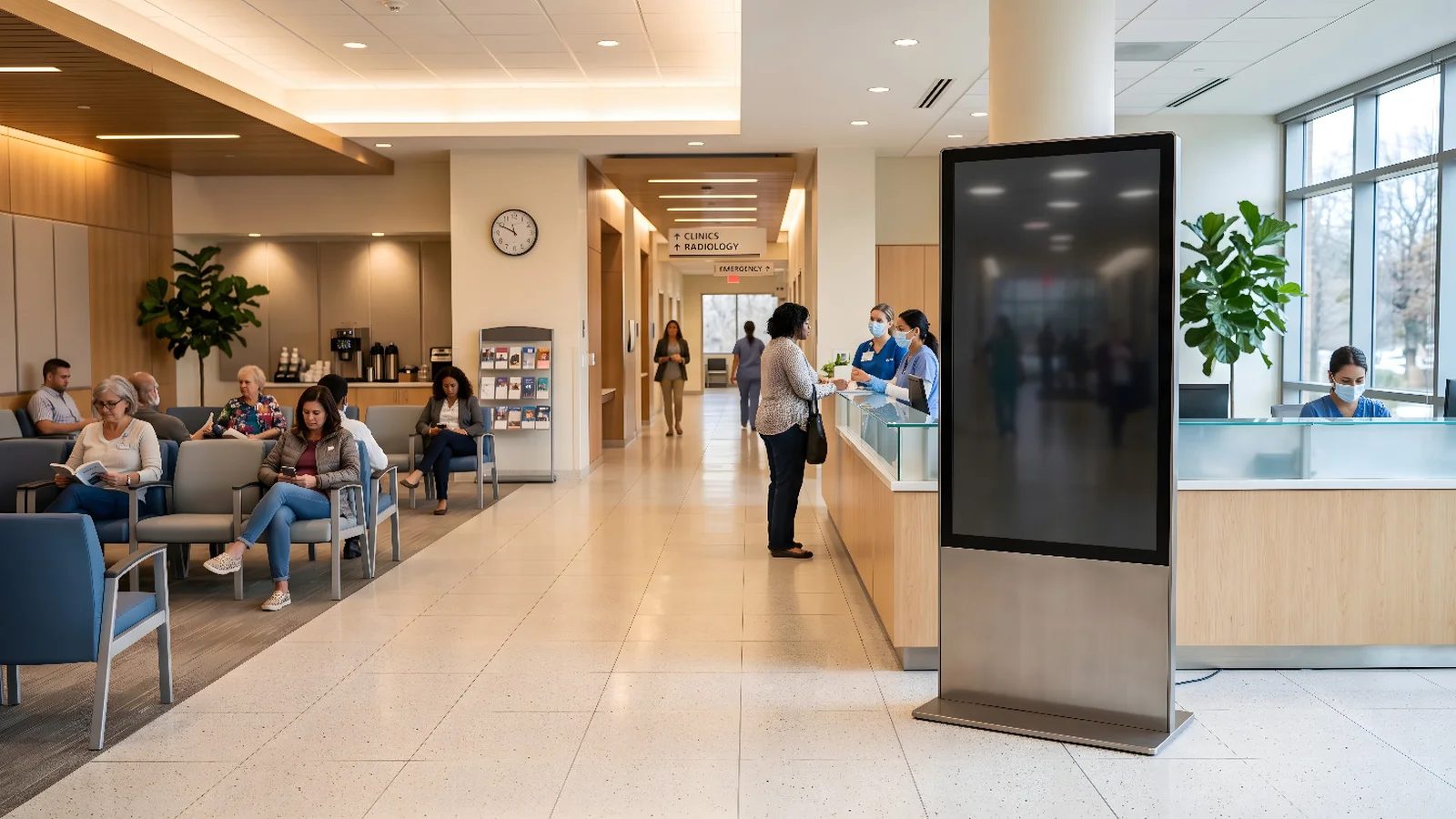
An opinion piece from PlaceBased Media managing director Cody Cagnina, published on Digital Signage Today, argues that place-based digital out-of-home screens in clinics and senior centers can close the gap between seeing a health message and acting on it, a gap the author says broad-reach media like billboards cannot close.
The piece lays out separate playbooks for two venue types. In clinics, Cagnina says waiting room screens should carry a single clear action rather than a list of risk factors, should be readable across a room, and should avoid using individual patient data to target content. He cites CDC data that 84.7% of U.S. adults saw a health care professional in 2025, and Census figures showing 8.4% of U.S. residents speak English less than "very well," to argue for multilingual, culturally adapted content. He also recommends pairing patient-facing waiting room content with separate messaging for staff in break rooms, so clinicians and patients arrive at the same conversation with shared context.
For senior centers, which the National Council on Aging says serve more than 1 million older adults daily, Cagnina argues repetition beats reach, recommending larger type, higher contrast, slower rotation and local calls to action like a clinic day rather than a URL.
The piece also addresses measurement. Cagnina points to Alliance for Audited Media audits of guaranteed distribution as a way for health departments and agencies spending public funds to verify screens ran where promised, citing a PlaceBased Media point-of-care program that delivered 113.3% and 111% of guaranteed distribution across two audits. He suggests buyers ask networks whether distribution is independently audited, whether there is venue-level time-stamped proof of posting, how playback is verified per screen, and what outcome measures such as QR scans or appointment lift are available.
The piece is a vendor perspective rather than an independent report, and does not disclose specific network pricing, screen counts, or named health system deployments beyond the author's own program.
The announcement in full
Reproduced from Digital Signage Today for reference. Digital Signage Magazine did not write the text below.
Health departments, health systems and community organizations are all asking how to reach people who don't respond to broad-reach media. Place-based DOOH in clinics and senior centers answers part of that by meeting people in the rooms where health decisions already happen.
November 10, 2026 by Cody Cagnina — Managing Director, PlaceBased Media
Most public-health messages fail at the same point: the gap between seeing something and doing something. A highway billboard can tell someone flu shots are available. It can't put them in a room where they can ask about one in the next 10 minutes.
That gap is why more health communicators are turning to place-based digital out-of-home: screens inside the venues where people already make health decisions. Clinics and senior centers are two of the most important, and they work for different reasons.
The clinic: A message next to the decision
A patient in a waiting room is already thinking about their health. They have time, and the person who can answer their question is a few feet away. The reach is broad, too: CDC data show 84.7% of U.S. adults had a visit with a doctor or other health care professional in 2025.
Point-of-care messaging works best when it's built for that moment, not adapted from a TV spot. A few rules:
Give one action. "Ask your provider about a shingles vaccine today" beats a list of five risk factors.
Write for the room, not the street. Dwell time supports a short explanation, but keep the headline readable from across the room.
Respect privacy. Content should be relevant to the venue type and specialty, never driven by individual patient data.
Match the language of the room. The Census Bureau's 2022 American Community Survey found that 8.4% of U.S. residents age 5 and older speak English less than "very well," and that share varies widely by community. In my own point-of-care work, materials run in English, Spanish and more than 15 additional languages. Cultural adaptation, not word-for-word translation, is what lands.
Most clinic campaigns are planned around patients. The people who work there deserve their own plan.
Physicians, nurses and medical assistants move through break rooms, staff lounges and exam rooms all day. Screens there reach healthcare professionals (HCPs) in the minutes between patients, when updated screening guidance or a referral resource can actually be absorbed.
HCP-facing content should be clinical, specific and sourced, not consumer advertising. When a patient sees a message in the waiting room and their clinician has seen a companion message in the break room, the exam-room conversation starts from common ground. That pairing, a patient prompt plus provider reinforcement, is one of the most underused tools in point-of-care planning.
Senior centers work differently. According to the National Council on Aging, more than 11,000 senior centers serve more than 1 million older adults every day. One study of New York City senior centers, cited by NCOA, found that 75% of participants visit one to three times a week and spend an average of 3.3 hours per visit.
Here, repetition matters more than reach. Older adults are the priority audience for many public-health efforts: vaccines, fall prevention, benefits enrollment, scam awareness and chronic-disease management. A message that shows up week after week in a familiar place, next to the meal program and the exercise class, carries credibility a social feed can't match.
Design matters, too: larger type, high contrast, slower rotation and plain language. A local, in-person next step, such as a clinic day at the center or a benefits counselor, fits the setting better than a URL.
Senior living communities extend the same logic. Residents, visiting family and staff share common areas, so one screen reaches three audiences who each influence a health decision.
There's one less glamorous reason healthcare buyers are leaning into place-based media: accountability. Agencies spending grant or taxpayer dollars must show the campaign ran where it was supposed to. "Trust us" doesn't survive a funder review.
The Alliance for Audited Media (AAM), which has verified media distribution since 1914, also audits guaranteed distribution for place-based programs. In my own work, a physician-office point-of-care program passed two consecutive AAM audits, delivering 113.3% and 111% of its guaranteed distribution. The specific numbers matter less than the principle: a neutral third party checked delivery location by location, and the result was a number, not a narrative.
Buyers evaluating any point-of-care or community network should ask:
Is distribution independently audited, and by whom?
Is there venue-level proof of posting, time-stamped and geo-tagged?
How is playback verified on each screen, not just at each venue?
What outcome measures can be layered on top, such as QR scans, call volume, or appointment and vaccination lift against matched control areas?
Verified delivery doesn't prove behavior change. But without it, nothing else in the measurement plan holds up.
Health departments, health systems and community organizations are all asking how to reach people who don't respond to broad-reach media. Place-based DOOH in clinics and senior centers answers part of that by meeting people in the rooms where health decisions already happen, in the language they speak, with proof the message actually ran.
The opportunity for the digital signage industry is to build these networks with the discipline the setting demands: respectful of privacy, designed for comprehension and accountable to the people paying for them.
From outpatient facilities to senior housing, changing care needs are creating new real estate opportunities. Join Connect Healthcare Real Estate, November 17–18 at the SLS Hotel, Beverly Hills, for timely insights into development, investment and the sector's next decade. Save your spot .
I've spent my career challenging the way advertisers think about reaching people beyond traditional media. As co-founder and Managing Director of PlaceBased Media, I'm passionate about connecting brands and organizations with audiences in the places that shape their everyday lives. I believe the future of advertising lies in creating meaningful connections through relevant environments, innovative media solutions, and measurable results.
Get the latest news and resources from Digital Signage Today.