Pixera Media Servers Drive 35 AV Systems at Obama Presidential Center
2026-10-07 · via AV Magazine
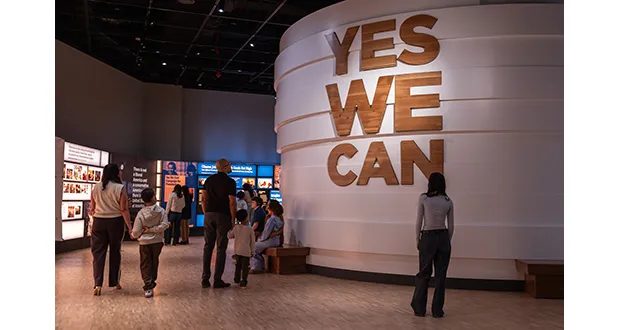
The Obama Foundation has deployed AV Stumpfl's Pixera media server platform to run all media playback across the Obama Presidential Center in Chicago, which opened to the public on 19 June 2026. The installation covers 35 separate systems across the museum's four public gallery floors, according to the company.
For anyone managing a large multi-venue AV estate, the project is a useful case study in consolidation. Rather than running different playback hardware for different exhibit types, the Obama Foundation's AV team standardised on one platform across 23 single-display exhibits, seven multi-monitor systems (including configurations of up to 11 displays off a single director server and two clients) and five multi-projector systems. The company says server models were matched to each exhibit's technical demands, drawing on the full Pixera hardware range rather than a single fixed spec.
The centrepiece is Power of Words, a four-storey projection installation that runs the full interior height of the building and expands across all four gallery levels simultaneously. Jeremy S. Bloom, the sound designer on the project, says the audio design uses more than 89 speakers embedded in screens, floors and ceiling trenches, and that Pixera let him mix and spatialise audio on site by sending LTC timecode to the media server over the existing Dante network, rather than relying on a dubbing stage.
Variable screen geometry
One operational detail worth noting: the Power of Words screen is wider at mid-level floors than at the top and bottom, meaning different content warps were needed depending on vertical position. The team addressed this using Pixera's NDI live-input capability, feeding full-resolution After Effects compositions directly into Pixera at full scale so warping and content changes could be previewed and adjusted in real time, instead of waiting on repeated offline renders.
Paul Horst, senior manager of exhibition AV systems at the Obama Foundation, says the team also built a six-foot scale model of the Power of Words screen using smaller Pixera servers and compact projectors before committing to the full-size build, to test mapping, audio sync and control workflows in advance.
For day-to-day operation, the team built custom web-accessible control panels in Pixera Control, exposing only common functions, starting and stopping timelines, toggling outputs, restarting the render engine, and selecting stills, so technicians without deep software knowledge can run the systems. Those panels are embedded within Isaac, the museum's wider control platform, giving operators a single point of access to the full media estate.
The announcement does not disclose project cost, installation timeline, or how the system is being maintained post-launch. It also does not name other media server platforms considered before Pixera was selected.
The announcement in full
Reproduced from AV Magazine for reference. Digital Signage Magazine did not write the text below.
By AV Magazine in Media servers , US&Canada , Visitor attractions October 7, 2026 0
The Obama Foundation selected Pixera to unify media playback across Chicago’s new presidential museum, spanning a multitude of media exhibits and a four-storey immersive projection piece.
The Obama Presidential Center opened to the public on 19 June 2026 in Chicago’s Jackson Park. The date was chosen deliberately, as Juneteenth is a United States federal holiday that marks the emancipation of enslaved African Americans.
Following a dedication ceremony attended by dignitaries, the nearly 20-acre campus opened its doors to the general public. The Center rises across eight floors, four of them given over to public museum space, presenting exhibitions that explore the story of President Barack Obama and Michelle Obama through film, interactive displays, and large-scale immersive media.
Barack Obama was the first United States president to hold a Twitter account, the first to livestream from the Oval Office on Facebook, and the first to answer questions from the public on YouTube. That relationship with digital technology is a central theme of the museum, where AV Stumpfl Pixera media servers drive 35 distinct systems spanning the full breadth of the exhibition programme.
Paul Horst, senior manager of exhibition AV systems at the Obama Foundation, led the AV design and deployment across the museum. With exhibits ranging from individual 4K displays to large multi-projector installations, the team required a media server platform capable of scaling across every use case within a single, managed ecosystem.
“We selected Pixera to consolidate our media playback into a unified ecosystem,” says Horst. “It provided both the hardware options needed to suit individual exhibit sizes and the comprehensive software required to execute our most ambitious installations.”
The 35-system installation spans 23 single-display exhibits, seven multi-monitor systems and five multi-projector systems. The multi-monitor configurations include systems of up to 11 displays, each running from a single director server and two client units. The five multi-projector systems range from two-projector blends to the four-storey Power of Words installation. The deployment draws on the full breadth of the Pixera hardware range, with server models matched to the technical requirements of each individual exhibit.
Across all systems, the Obama Foundation’s AV team built custom web-accessible control interfaces within Pixera Control, making routine operations accessible to technicians without requiring in-depth knowledge of the software. Each interface provides the most common operator functions, like starting and stopping timelines, toggling outputs, restarting the render engine, and selecting photography-safe stills from the video content. The interfaces are available as embedded panels within Isaac, the museum’s integrated control platform, giving operators access to the full media estate from a single location.
Power of Words is the museum’s centrepiece installation, running the full interior height of the building across all four gallery floors as a projected canvas that orients visitors on each level before expanding into themed visuals and artwork that cross every storey simultaneously. The spatial audio design, led by Emmy Award-winning sound designer Jeremy S. Bloom, deploys more than 89 speakers across the installation, with audio systems embedded in screens, floors, and in ceiling trenches at each level.
“At site-specific immersive installations like those in the museum, mixing and spatialising the audio onsite is not only fun, but a complete necessity,” says Jeremy S. Bloom, sound designer. “Onsite, without the traditional infrastructure of a dubbing stage, I need a way to finalise the audio on my own workstation while watching the final visual media at scale. Pixera allowed for this quite seamlessly. With the flip of a switch, I could send LTC timecode to the media server over our existing Dante network and gain control of all playback.”
The projection geometry of Power of Words presented an additional challenge. The screen is wider at the mid-level floors than at the top and bottom of the building, requiring the media producers to apply different content warps depending on the vertical position of each element on the canvas. To address this, the team developed a workflow using Pixera’s NDI live-input capabilities, taking full-resolution After Effects compositions as direct NDI feeds into Pixera and displaying them on the full-scale screen in real time. Warping corrections and content changes could then be previewed and refined immediately, without the delays of iterative offline renders.
Before the full Power of Words installation was commissioned, Horst’s team built a six-foot scale model of the screen to work through the projection geometry and workflow challenges in advance. Smaller Pixera servers and compact projectors replicated the final installation conditions at bench scale, allowing the team to validate the mapping, audio synchronisation and control workflows before committing to the full build. “When we installed the full-sized systems at the Obama Presidential Center Museum, we had a high degree of confidence that the system would work because we had already built it,” says Horst.