Playipp Adds Natural-Language AI Assistants For Screen and User Management
2026-11-17 · via invidis
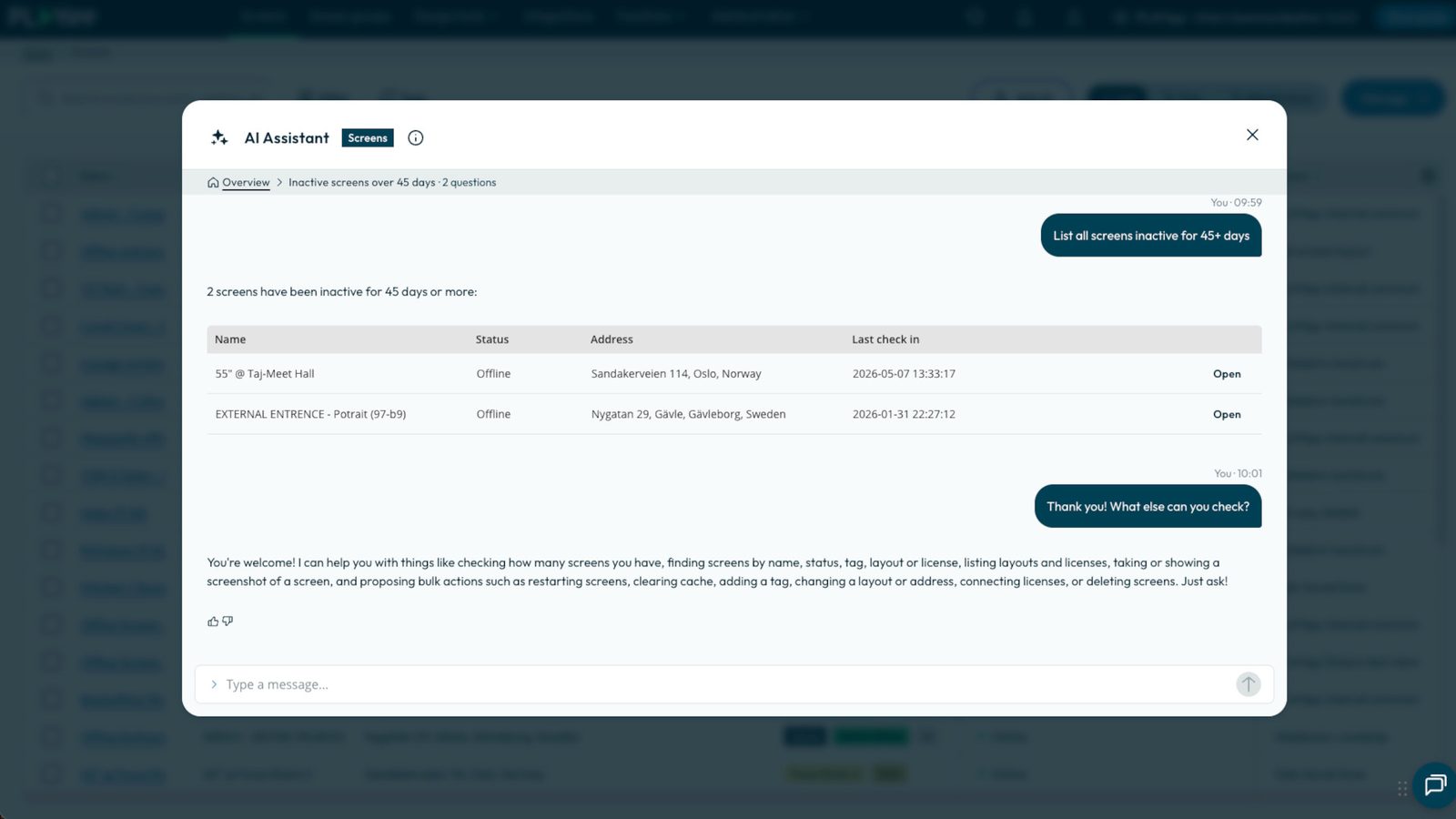
Swedish digital signage software provider Playipp has added two AI assistants to its platform that let network administrators manage screens and user permissions through conversational commands rather than menu navigation. For operators running large screen networks, the pitch is less time spent hunting through dashboards for routine fixes.
The first tool, the Screen Management AI Assistant, gives administrators an overview of their network through plain-language queries. According to the company, users can ask which screens are offline, find displays that have gone inactive for extended periods, or pull screenshots from individual screens, with results shown as tables, charts or lists.
It also handles administrative tasks: restarting screens, clearing caches, changing layouts, assigning licenses and updating screen locations. Playipp says multiple actions can be carried out in a single conversation, which could cut down on the back-and-forth clicking that comes with managing networks spread across many locations.
The second tool, the Users and User Groups AI Assistant, is built for access control. Administrators can check who has what permissions, identify which colleagues hold admin rights, invite new users, or block, unblock and remove accounts, again through natural-language requests rather than digging through settings menus.
Both assistants respond in whatever language the administrator uses, so there is no command syntax to learn, according to Playipp.
Guardrails and data location
Given that these assistants can make changes to live networks, Playipp has built in some constraints. Before executing anything, the assistants show which screens or users will be affected and require explicit approval from the administrator. Actions are also limited to whatever access level that administrator already holds, so the AI cannot be used to exceed existing permissions.
On data handling, Playipp says the AI models run on infrastructure hosted in the European Union by Swedish provider Berget, that customer data stays in Europe, and that it is excluded from AI model training. Organizations that do not want to use the feature can switch it off entirely.
Thomas Sundgren, Playipp's chief product officer, said the tools are meant to take over routine administrative work tied to keeping screens online, managing licenses and controlling user access.
The announcement does not say when the assistants will be generally available, whether they carry an additional cost on top of existing Playipp licenses, or how they compare in scope to AI features other CMS vendors have introduced for network troubleshooting. For operators evaluating CMS platforms, the approval-step design and EU data hosting are likely to matter as much as the feature list itself, particularly for public sector and regulated retail deployments where data residency is a procurement requirement.
The announcement in full
Reproduced from invidis for reference. Digital Signage Magazine did not write the text below.
The Swedish software provider has introduced two AI assistants that let administrators manage screens, licenses and user permissions through natural-language requests, with approval required before changes take effect.
Swedish digital signage software provider Playipp has launched two AI assistants designed to simplify network administration, allowing users to manage displays and access permissions through conversational commands.
The Screen Management AI Assistant provides administrators with an overview of their digital signage networks. Users can ask which screens are offline, identify displays that have been inactive for extended periods, or retrieve screenshots from individual screens. Results can be presented as tables, charts or lists.
Beyond monitoring, the assistant can perform administrative tasks such as restarting screens, clearing caches, changing layouts, assigning licenses and updating screen locations. Multiple actions can be handled in a single conversation, reducing the need to navigate different software menus.
A second tool, the Users and User Groups AI Assistant, focuses on access management. Administrators can check user permissions, identify colleagues with administrative rights, invite new users, and block, unblock or remove existing accounts.
Both assistants support natural-language interaction and respond in the language used by the administrator, eliminating the need to learn specific commands.
Playipp has incorporated several safeguards into the system. Before making changes, the assistants display which screens or users will be affected and require explicit approval. They also operate within each administrator’s existing access permissions.
The company says the AI models are hosted in the European Union by Swedish provider Berget, with customer data remaining in Europe and excluded from AI model training. Organizations can also disable the assistants entirely.
Thomas Sundgren, chief product officer at Playipp, said the tools address routine administrative work involved in keeping screens online, managing licenses and controlling user access.