Seedtag Uses LED Trucks With Robot Props to Promote Ad Philosophy in Manhattan
2026-10-10 · via invidis
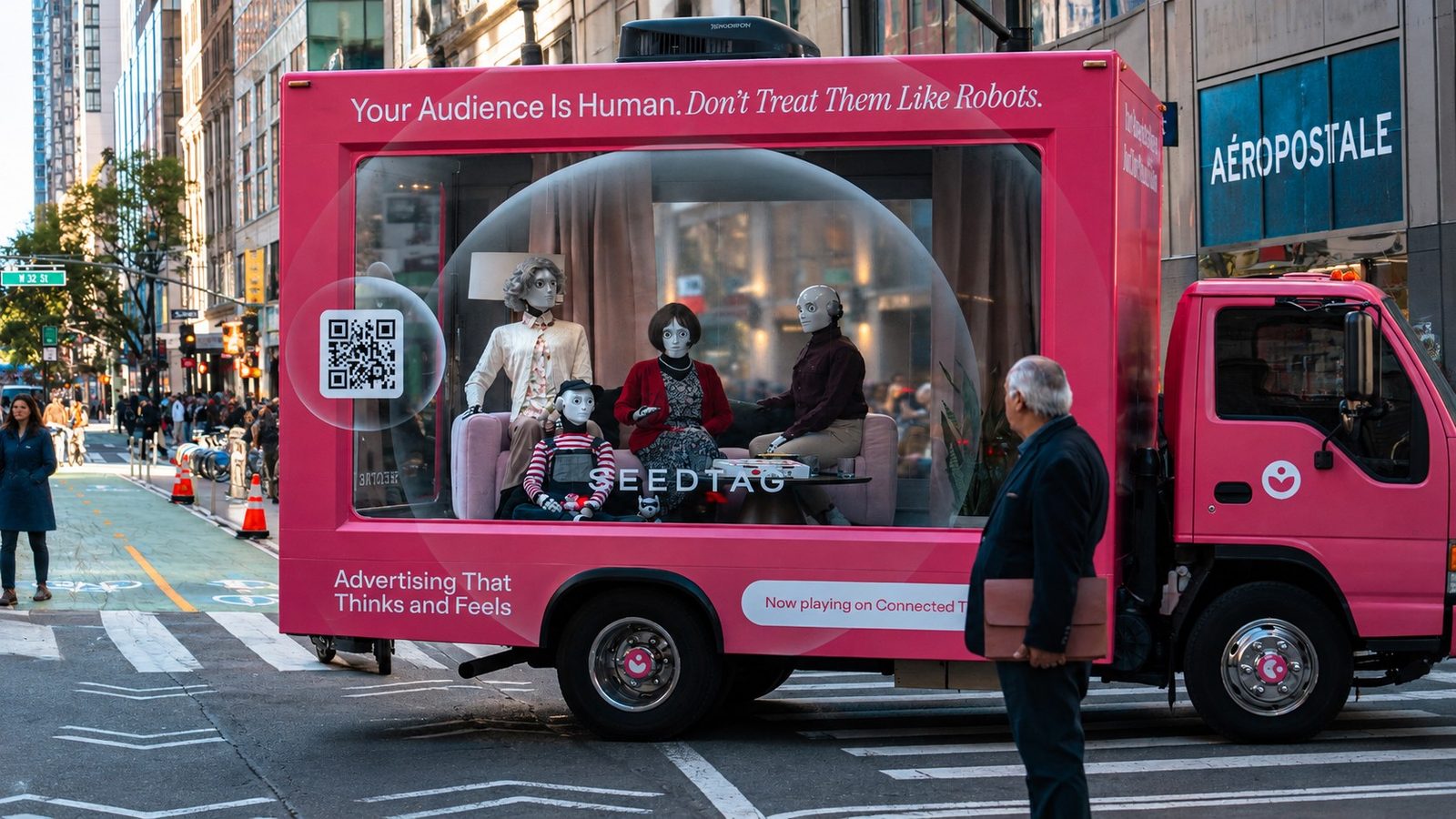
Seedtag, an advertising technology company, drove trucks fitted with digital screens and humanoid robot props through Manhattan on Oct. 6, timed to coincide with Advertising Week New York. The vehicles carried the message "Your audience is human. Don't treat them like robots," according to the company.
For operators running mobile LED truck fleets or managing DOOH inventory, this is another data point in a growing trend: brands and ad tech vendors using mobile billboard activations as stunts timed to industry events rather than as sustained local advertising buys. The campaign ran near event venues rather than across the city generally, which suggests a short, targeted placement built for press coverage and social sharing rather than broad reach.
Seedtag says it specializes in what it calls neuro-contextual advertising, using AI to analyze the content audiences are consuming to infer interest, intent and emotion, rather than relying on personal data collection. The robot truck campaign was built to dramatize that pitch: a visual of robots staring blankly at screens, positioned as a contrast to Seedtag's claimed human-centered targeting approach. The announcement does not say how many trucks were involved, what screen specifications were used, or whether the activation included any measurement of impressions or engagement.
Part of a wider mobile OOH pattern
The piece notes this follows a similar tactic used in July, when eyewear company Blacksheep deployed 25 LED trucks outside Google's Manhattan offices to protest ad charges tied to a technical issue on its website. That campaign and Seedtag's share a format: coordinated fleets of mobile digital screens used to deliver a pointed message in a dense, high-foot-traffic area, rather than a conventional static billboard buy.
For digital signage and DOOH operators, the pattern is worth watching. Mobile LED trucks remain a flexible way to generate attention around conferences, product launches or corporate grievances, without the lead times or fixed costs of static billboard placements. They also generate press coverage on their own, as both the Blacksheep and Seedtag campaigns did, which can matter more to the sponsoring brand than raw impression counts.
What is missing from the announcement is any detail on cost, screen vendor, truck fleet size, or audience measurement data. Readers evaluating whether this type of activation is worth replicating for a client campaign will not find hard numbers here, only a description of the creative concept and its media coverage.
The announcement in full
Reproduced from invidis for reference. Digital Signage Magazine did not write the text below.
The advertising technology company used trucks carrying humanoid robots during Advertising Week New York to highlight the importance of treating audiences as people rather than data points.
Seedtag took an unusual approach to promoting its advertising philosophy during Advertising Week New York, sending trucks carrying humanoid robots through Manhattan.
The vehicles circulated near event venues on Oct. 6, displaying groups of robots staring at advertising screens. The activation carried the message: “Your audience is human. Don’t treat them like robots.”
The campaign was designed to draw attention to what Seedtag sees as a problem with AI-driven advertising: treating consumers as targets defined by algorithms rather than individuals with interests and emotions.
Seedtag specializes in what it calls neuro-contextual advertising, using AI to analyze the content audiences consume and identify signals of interest, intent and emotion. The company argues that this approach allows advertisers to deliver more relevant messages without relying on intrusive personal data collection.
The activation is another example of brands using mobile advertising vehicles to attract attention on Manhattan’s streets.
In July, eyewear company Blacksheep deployed 25 LED trucks outside Google’s Manhattan offices to protest advertising charges following a technical issue affecting its website.
While the two campaigns had different objectives, both used coordinated mobile advertising activations to deliver messages beyond conventional billboard placements.