Wisconsin District Cuts Lockdown Alert Time in Half Using Signage Screens
2026-10-05 · via Digital Signage Today
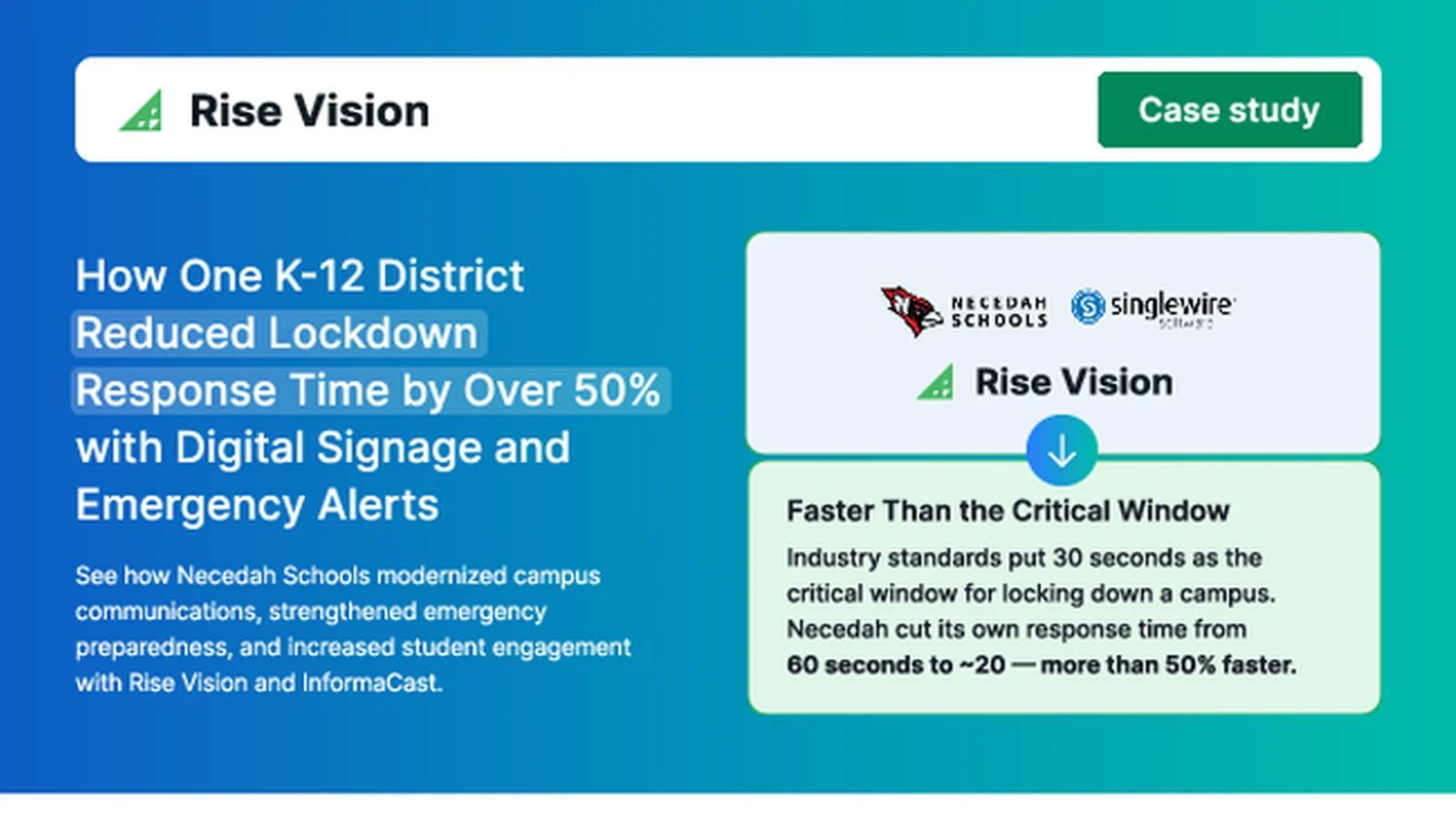
Necedah Schools, a K-12 district in central Wisconsin, says it cut its lockdown response time from 60 seconds to about 20 seconds after integrating its Rise Vision digital signage platform with Singlewire's InformaCast emergency alert system. The district frames this as more than a 50% reduction, landing inside what it describes as a 30-second industry standard for critical response.
For anyone managing screens in a school, hospital, or office building, this is a useful case study in treating signage as more than a content channel. Necedah's previous system relied on an audio-only PA setup that required staff to run through multiple manual steps before an alert reached the full campus. That kind of latency is a real liability in a lockdown scenario, where seconds determine whether every room gets the message before a threat escalates.
The integration works by giving staff a single quick-click trigger that overrides whatever is currently playing on connected displays, speakers, and classroom clocks, pushing the emergency message to every endpoint at once. Instead of signage being a separate system that has to be manually updated during a crisis, it becomes a second channel that fires automatically alongside audio alerts.
What this means for operators
The pairing of a CMS platform with a dedicated mass-notification system like InformaCast is not new in the education and enterprise safety markets, but this case shows the practical payoff when the two are wired together rather than run in parallel. Operators running signage networks in schools, campuses, or large facilities should note that the time savings here came from removing manual steps, not from faster hardware or network upgrades. That is a workflow and integration story, not a display story.
The announcement does not say what hardware the district uses for its displays, speakers, or classroom clocks, nor does it detail the cost or timeline of the rollout. It also does not explain how the system handles partial outages or screens that are offline when a trigger fires, a question any IT administrator evaluating a similar setup would want answered before committing budget.
For districts or facilities still running audio-only PA systems, the Necedah example is a pitch for treating existing signage infrastructure as a redundant alert path rather than adding a separate notification layer from scratch. Whether that approach scales to larger or more complex campuses, with more endpoints and more network variability, is not addressed in the release.
The announcement in full
Reproduced from Digital Signage Today for reference. Digital Signage Magazine did not write the text below.
Necedah Schools, a K-12 district in central Wisconsin, needed a faster way to lock down its campus in an emergency. Its legacy PA system was audio-only and required staff to complete multiple manual steps before a message reached the whole campus—a real liability when industry standards set the critical response window at just 30 seconds.
The district replaced that process with Rise Vision digital signage integrated with Singlewire's InformaCast emergency alert system, turning its existing screens into a second channel for emergency communication. A single quick-click trigger now overrides regular signage content across every connected display, speaker, and classroom clock at once.
The result: Necedah cut its lockdown response time from 60 seconds to about 20 — a reduction of more than 50%, and well inside that critical 30-second window. See how Rise Vision and InformaCast worked together to modernize Necedah's emergency communications, and what other districts can take from the rollout.
Rise Vision is the All-in-one Platform for Digital Signage, Screen Sharing, & Emergency Alerts
Rise Vision helps you communicate, teach, collaborate, and improve safety affordably with easy cloud-based digital signage, screen sharing, and emergency alerts—all backed by world-class support and flexible hardware options.